

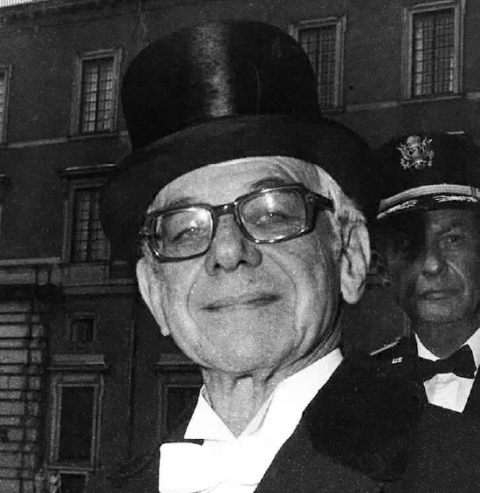
Robert Strausz-Hupé – Founder, Foreign Policy Research Institute
The following is an introduction by Robert Strausz-Hupé to Volume 1, Issue 1 of Orbis, published in 1957.
America, in the years following World War II, has achieved a rate of economic growth and a general level of prosperity unparalleled by any nation in any period of history. This domestic achievement is counter-balanced on the international front by an unprecedented threat to this nation’s future security. Soviet communism has built a war machine which matches or surpasses that of the West in many significant respects. Repeatedly the best estimates of United States authorities concerning Soviet technological capability have proven inaccurate.
The Soviets have broken the atomic monopoly; they have made rapid strides in the development of their strategic air power and industrial potential; Soviet conventional outnumber those of the West. America, despite her great military and economic strength, has far been unable to galvanize the West into effective counter force, even though the Hungarian and Polish uprisings and unrest within the Soviet Union offer valuable opportunities to be seized.
To meet the threat and to seize ties requires that the best and most experienced minds be brought to bear on the key issues on which the nation’s long range future hinges. The Foreign Policy Research Institute of the University of Pennsylvania was established in 1955 by a small group of men, trained in a variety of intellectual disciplines, and joined together by their common interest in foreign affairs.
The objectives of the Institute are first, to study major problems of United States foreign relations, and secondly, to suggest concrete policies designed to deal with these problems most effectively. The work of the Institute is specifically directed towards the production of basic studies which will be of value in the formulation of future American policies, the development of methods appropriate to basic research in international relations, and the training of competent research workers.
Not all of the Institute’s studies lend themselves to publication in book form. Hence, Orbis, a quarterly, will supply a much needed outlet for the Institute’s materials. Its role, however, is not so much that of a house organ, for Orbis will not limit itself to contributions by members of the Institute.
Orbis will solicit articles and review from contributors in the United States and other countries. It will make available to the American public writings from abroad which are not easily accessible even to American specialists in foreign affairs.
II.
The Foreign Minister of Italy, Norway and Canada submitted at the end of 1956 their Report on Non-Military Cooperation in NATO. This document strieks the right note at the right time. The North Atlantic Community has served a useful purpose, for it has created a shield behind which Western Europe could regain its moral and economic strength. Thanks to NATO, the threat of overt communist aggression, which loomed large in 1950, was averted. Meanwhile, however, some of the underlying assumptions of NATO strategy have proven inadequate, others out of date. The events in the Middle East revealed the geo-political range of NATO as too narrow; the recent technological innovations put in doubt the military effectiveness of NATO. The question arises as to whether the strategic and technological weak-nesses of NATO can be remedied without a fundamental .reappraisal of the nature and purposes of North Atlantic cooperation. The Report of the Three suggests that beyond the strategic and technological dilemmas of NATO lies a more fundamental problem: how to achieve greater political, economic, and cultural cooperation on the basis of a common tradition. The Report states:
There was a feeling among the government and peoples [of NATO] that this closer unity was both natural and desirable; that the common cultural traditions, free institutions and democratic concepts which were being challenged, and were marked for destruction by those who challenged them, were things which should also bring the NATO nations closer together, not only for their defense but for their development. There was in short a sense of Atlantic Community, alongside the realisation of an immediate common danger.
Gratifying as is the statement of the Three, it should be noted that in nearly seven years the NATO powers have been unable to develop an effective means of giving substance to Article 2 of the Atlantic Alliance. This Article provides that:
The Parties will contribute toward the further development of peaceful and friendly international relations by strengthening their free institutions, by bringing about a better understanding of the principles upon which these institutions are founded, and by promoting conditions of stability and well-being. They will seek to eliminate conflict in their international economic policies and will encourage economic collaboration between any or all of them.
Since its inception, the Foreign Policy Research Institute has centered its energies upon bringing Article 2 to life. Acting upon the conviction that common cultural concerns are the only durable bonds uniting any community, FPRI, joined by the College of Europe, has called a meeting of Western intellectual leaders. The Conference on the North Atlantic Community, scheduled for September 8, 1957, in Bruges, will explore the ways and means for strengthening the cultural foundations which support Western military, political and economic cooperation.
The crisis of NATO which simmered for many months over the organization and distribution of the allied armed forces erupted in the spectacular disagreement over Middle Eastern policy. It is painfully obvious that the absence of appropriate political consultation has long been at the root of NATO’s troubles. The Report of the Three points to this manifest short-coming of NATO. Its recommendations, sound as they are, fall short of prescribing adequate remedies. The Three could not do otherwise, for they could not cut loose from the restrictions which the mood of governments and parliaments imposed upon them. Governments and parliaments will yield to the pressures of public opinion. Such pressures will arise only from a growing awareness of the shared interests and common destiny of the North Atlantic Community.
III
The Report of the Three expresses not only the hope for closer North Atlantic cooperation; it shows also the need to make NATO’s constructive purposes better understood in non-NATO countries and to convince the non-Western peoples
that NATO is not tending now to become an agency for the pooling of the strength and resources of the “colonial” powers in defence of imperial privileges, racial superiority and Atlantic hegemony under the leadership of the United States. The fact that we know these views to be false and unjustified does not mean that NATO and its governments should not do everything they can to correct and counteract them.
It has become a cliche to say that we are living in a “revolutionary age of global compass.” The truth behind this cliche, albeit a simple one, is not always understood clearly. It is not the communist revolution alone which we face. Two greater and more consequential transformations are making history in the second half of the twentieth century: the unification of the North Atlantic Community and the self-assertion of the long-dormant non-Western world. In March 1957, the Vice President of the United States traveled to Ghana, the new African state formed out of the British Gold Coast and British Togoland, to rep-resent the United States at the ceremony of independence, and hence to the Sudan and Libya. These visits-of-state signify poignantly a change not only in the territorial distribution of national sovereignties but also in political conceptions–a change which, ten years ago, was hardly envisaged by anyone. All throughout history, territories have changed hands. The voluntary devolution of empire is a novel phenomenon; so is the virtually automatic graduation into the United Nations on a basis of full equality-of peoples·that only yesterday were classed as “backward” or “primitive.” And if nothing in this development were historically new, then surely the speed of the transformation is without precedent. The rise of new states in Asia and Africa poses most serious problems both for the non-Western and the Western world. It will be a long painful process to compound an accommodation be-tween West and non-West, for the preceding era of Western pre-dominance has left behind a host of real and imagined grievances.
“Orbis will seek to clarify some of the issues that beset the relationship of the two parts of mankind who both face the threat of the communist bid for universal dominance in the name of an all-inclusive and militant creed.”
Orbis will seek to clarify some of the issues that beset the relationship of the two parts of mankind who both face the threat of the communist bid for universal dominance in the name of an all-inclusive and militant creed.
IV
The events of the fall of 1956 afford a glimpse of communist prospects that, for once, reveals the limits of communist power. Khrushchev’s attempt to save Stalinism by sacrificing Stalin and by attributing the crisis of the system to the shortcomings of the once adulated leader opened fissures that, thus far, neither dialectical finesse nor brute force have been able to close. Despite, and not because of, the present Soviet leadership, de-Stalinization proceeded at least in one important field: the Presidium of the Soviet, meeting in December 1956, had to abandon the latest Five-Year Plan and shelve, at least for the time being, the ruthless policies of forced saving and over-investment in heavy industry which, since 1928, had led to a growing neglect of consumer goods production and of the people’s welfare and had reduced workers and peasants to a state of serfdom.
It would be most surprising if the Soviet leadership, reared in the Stalinist tradition, would embrace enthusiastically a program of approximating the welfare state and try to carry it out. Slogans, however, have a life of their own. To the consternation of the Soviet leaders, such slogans as “the fight against the Cult of Personality” and the legitimacy of “various roads to socialism in the different countries” engaged the imagination of the peoples under communist rule and sparked, at least in part., the events in Poland and Hungary. For forty years the dynamism of the communist movement has been generated exclusively from above; now, for the first time, the masses have begun to stir and to grope for their image of “socialism.” If it ever was proven that men cannot live by bread alone and that men’s actions are not primarily determined by economic factors, it was so proven recently in communist lands. In the Soviet Union and, above all, in Poland and Hungary the intellectuals, an economically privileged group under communism, took the initiative in voicing the protests against the regime and in demanding cultural freedom. Among their leaders were many recipients of Stalin Peace Prizes and of highest Soviet honors. In a Warsaw radio broadcast on April 1, 1956, entitled ”The New Spring,” Irene Kraywicka spoke of the “explosion of truth.” At the trial of the workers of the former Stalin Works in Poznan, who not only demonstrated for bread and liberty but also demand-ed free elections, Professor Jozef Chalasinski, Poland’s leading sociologist, openly declared that the police, the moment it fired upon the demonstrators, ceased “to be for the people the symbol of the law,” and that, therefore, “the at-tack upon the police was no longer a crime but an act of liberation and justice.” Voices are now being heard on the market places and in the literary forums of Poland that only yesterday were stilled by censorship, just as, in October 1956, the deeds of the Hungarian workers and students, unthinkable six months before, shook the structure of the Soviet Empire.
V
The emancipation of Asia and Africa from the tutelage of Europe affects not only the Free World but also the communist orbit. An event of great significance was the journey, last January, of Chou Enlai, the Foreign Minister of Communist China, to Warsaw, Budapest and Moscow. In the strained relationship between the Soviet Union and its eastern European satellites, both sides appealed to the Chinese communists for their good offices. The Chinese communists’ statements on the strict unity of the communist world and the right to choose “autonomous” roads to “socialism” were awaited with anxiety in Belgrade and War-saw and perhaps even in Moscow. For the first time in history, China entered as an active factor in what may be regarded as purely Euro-pean controversies. At the same time, Red China, probably independently from Moscow, intensified its activities in Asia. In recent months, Chou Enlai paid three visits to India and Burma. At the occasion of the last, he traveled to Nepal.
The Red Chinese gesture towards Nepal deserves special attention. As the Russian communists have set their hearts from the beginning on reestablishing and expanding the Russian. empire-in a form which surpassed that of the tsarist regime in centralizing efficiency-so the Chinese communists uphold the claims and traditions of the former Chinese empire. The Chinese communists put an end to the semi-autonomous status of Tibet and Sinkiang. They now hint broadly at the historical connection of former “dependent” or “vassal” lands with China.
Both the Chinese nationalists and communists have maintained that these dependent territories have been alienated from the Chinese empire by imperialist powers –Japan (succeeded by the United States) in the case of Korea and Taiwan; Great Britain in the case of Burma, Nepal and Bhutan. The two latter states were until very recently entirely inaccessible Himalayan border-lands between Tibet and India. Under the treaty of Sagauli of 1815, a British envoy was accredit-ed to the court of Nepal, and his presence was a guarantee of Brit-ish interest in Nepalese independence. A similar relationship existed between Britain and Bhutan. After India achieved its independence, the government of India acted to replace the British government as the guardian of Bhutanese and Nepalese independence. In recent years, the two Himalayan states, especially Nepal-by far the more important one-were opened to relations with the outside world. With the reestablishment of the Chinese grip on Tibet, Nepal and Bhutan have gained an added strategic importance.
Chou Enlai’s visit to Nepal may be followed by the building of a road from Lhassa in Tibet to Katmandu, the Nepalese capital. There is another reason why the steadily enhanced position of Communist China bears upon the fate of the free Asian nations : many millions of Chinese descent are holding important economic positions throughout Southeast Asia, especially in Singapore and in the Malay states which are to gain their independence from Britain this year. The ideal solution would be the assimilation of these Chinese into loyal and faithful citizens of the countries in which they live and prosper. Yet many signs point to their unwillingness or in-ability to undergo such a process of integration. In the meantime, the danger exists that these large and important Chinese settlements become Auslandschinesen, corresponding to the position which the German National Socialist regime assigned to the Germans living abroad. These Chinese might form, in the countries of their residence, powerful “fifth columns” operating in the interest of Chinese communism. Nowhere would such a development involve as great a strategic peril for free Asia as in Singapore. It is therefore highly desirable to develop Taiwan into an in-dependent, modern and thriving state and thus create a powerful center of attraction for the mil-lions of Chinese overseas. The remarkable achievements accomplished in the last years by the Republic of China with the support of the United States and with an ever-growing participation of the local population have received little attention abroad, as little as the work of consolidation which Ngo Dinh Diem has effected against greatest odds and against general expectation in the Republic of Viet Nam. With good will, and under the leadership of capable and courageous men, the cause of Free Asia is in no way lost, even in the borderlands of the Chinese communist giant.
VI
More precarious is the position of Tito’s Yugoslavia on the other side of the communist orbit. Since 1948 Tito has tried to play the difficult game of straddling the fundamental issue of how to combine dictatorship and dogmatism with that’ minimum degree of liberty without which neither economic progress nor intellectual life are possible. His position before 1954 was relatively easy: he claimed to represent Leninism against Stalinist Russia. Since 1954 Stalin’s heirs in Russia, however, have also appealed to Leninism as the source of their inspiration and as the guiding star of their activities. The uneasy state of both Yugoslavia and post-Stalinist Russia has made it abundantly clear that the Leninist system, and not the Stalinist deviation, is responsible for the lack of liberty and for the economic maladjustment which have become synonymous with communist rule. In 1955 the Moscow leadership tried to establish more cordial relations with Yugoslavia. Since then these relations have deteriorated again to a point reminiscent of the situation before Khrushchev’s visit to Belgrade. What underlies this deterioration is not a difference in ideology but a struggle between Belgrade·and Moscow for power and influence in central-eastern and southeastern Europe. Tito has not abandoned his intention of playing the leading role in a Balkan federation which would include at least Bulgaria, but if possible also Ru-mania, Hungary and Albania. On the other hand, Moscow, whether under Stalin or Khrushchev, wishes to hold fast to its control of the Balkans. In 1945 the dream of a long line of Tsars seemed to come true: the communists were close to including the Straits of Constantinople and Greece within their sphere of control. The break be-tween Stalin and Tito in 1948, and the support given by Britain and the United States to Turkey and Greece, frustrated Stalin’s hopes.
Khrushchev’s effort to heal the breach with Tito has foundered, not because Tito is less communist or Leninist than Khrushchev or less hostile to democracy, but be-cause of the power struggles that divide the communist world. Any opposition to Moscow’s monolithic leadership of the communist world is to be welcomed in the interest of freedom. This argument has been advanced in justification of Western support given to Tito. But as regards an opening wedge for true liberty, there is hope for it, albeit a slim one, in Gomulka’s Poland rather than in Tito’s Yugoslavia. Milovan Djilas’ article, published in the New Leader on November 19, 1956, brought about his incarceration in Yugoslavia; a similar criticism of the regime might have gone unpunished in Poland. Be that as it may, the Djilas article is a sign of the deep ideological unrest which, by the end of 1956, troubled the communist mind everywhere. It is this unrest which invites the Free World to a reappraisal of its own stand and of its own aspirations, both within its own fold and in its relationship to the communist movement and empire.
To this purpose Orbis seeks to contribute..