
By Frzand Sherko
14 minutes
This article was orginally published in Volume 68, Issue 1, in January 2024.
Arguably, the Commander-in-Chief of the Iranian armed forces relies on four pillars to deter their enemies at sea: implementing asymmetric warfare tactics; improving Iran’s naval capabilities at the tactical and strategic levels; using naval proxy forces, and building regional and global naval alliances. The author evaluates these pillars and contends that it is time for the United States to consider building an Arab naval alliance in the Persian Gulf.
Iran’s current naval forces are influenced by four key factors from its past: the Persian Empire, Shia Islam, the Iran-Iraq War, and the necessity to counter the United States’ desire for regime change in Tehran. [1] US naval forces off the southern coast only add to Iran’s strategic fears. These interconnected threads have shaped the Islamic Republic of Iran’s national policy and defense strategy.
Throughout history, since (500 BCE), different Persian empires have approached naval power in different ways. The Achaemenid Dynasty (550– 330 BCE) utilized naval power to expand its empire, while the lack of a navy contributed to the collapse of Sassanian Persia in the face of an Arabian Islamic invasion. In modern times, the Islamic Republic of Iran’s navy serves two purposes: to shift the battleground of the war with Iraq (1980-88) and to balance the deterring force of the US Navy in the Persian Gulf, the Strait of Hormuz, and the Arabian Sea since 9/11.
Iran is a continental state despite its potential for maritime power due to its location. Iran has a vast coastline of 1864 Mile, surrounded by the sea to the north and south. [2] This geographical location presents both strategic opportunities and existential threats to Iran. The Caspian Sea in the north, a wealthy sea shared by five countries, has been entrusted to the Islamic Republic of Iran Navy. [3] The southern coastline of Iran overlooks the Persian Gulf, the Strait of Hormuz, and the Sea of Oman. The Sea of Oman is Iran’s link to the Blue Seas and provides it with maritime diplomatic opportunities that are represented by the Islamic Republic of Iran Navy. Furthermore, the Persian Gulf and the Strait of Hormuz are considered to be within the boundaries of Rimland theory, which is crucial to both Iran and US security. According to political scientist Nicholas Spykman, “Who controls the Rimland rules Eurasia, who rules Eurasia controls the destinies of the world.”[4] This makes the Strait of Hormuz a conflict zone between the two countries. Iran focuses on the Strait of Hormuz, a key route for 40 percent of the world’s energy and a conflict zone where Persians and Arabs, Shiites and Sunnis clash. [5] The “revolutionary regime” sees the United States as an existential threat and is responding by countering its sea presence.[6] The Iranian Commander-in-Chief oversees nine naval command bases, including five Islamic Revolutionary Guard Corps Navy (IRGCN) bases and four army naval bases, the Islamic Republic of Iran Navy (IRIN). These bases are situated along the Gulf of Oman, the Strait of Hormuz, and the Persian Gulf, stretching from Mahshahr Port to Chabahar Port.[7] The conventional IRIN forces are the larger musical instruments in this naval symphony. In comparison, the IRGCN utilize smaller naval instruments to serve as insurgency forces in Iran’s deterrence strategy.
IRIN + IRGCN
Iran’s governing system involves the use of parallel institutions. Despite having both a leader of the Islamic Revolution and a president of the republic, there are also two intelligence agencies—the government affiliated Ministry of Intelligence and Organization of Intelligence of the Islamic Revolutionary Guard Corps, which reports to the leader of the Islamic Revolution. Iran has a Ministry of Foreign Affairs parallel to it, the Revolutionary Guards’ Quds Force, which also handles foreign affairs with other countries and non-state actors. From this unique standpoint for governing the ideological state, two separate naval forces operate under the Tehran regime: the Islamic Revolutionary Guard Corps Navy and the Islamic Republic of Iran Navy. The naval forces of the IRGCN and the IRIN combined consist of around 49,000 personnel. [8] The Iranian military ranks 17th globally, with its Navy classed 32nd among major fleets by “Global Firepower” in 2023.[9] Within the Iranian Armed Forces framework, both branches are accountable to the Supreme Leader and Commander-in-Chief of the Islamic Revolution, Ayatollah Ali Khamenei, through the Armed Forces General Staff. In his design, Khamenei regards the IRIN as Iran’s strategic navy, while the IRGCN is seen as a tactical force (Group 2023). According to Joseph Nye’s definition of Soft Power (Coutu 2008), the IRIN is an example of naval soft power, while the IRGCN is considered hard power. These two branches work together to promote Iran’s smart power at sea. As a result, Iranian naval strategists have adopted a mixed approach, combining conventional naval strength with hybrid warfare tactics.[10] The IRIN represents conventional naval power in this sea display, while the IRGCN plays a role in asymmetric warfare. Iran’s two navies operated separately before 2007, stationed along the north and south coasts. After implementing a naval strategy, each navy was assigned specific operational areas. The IRGCN defends the Persian Gulf and Strait of Hormuz, while the IRIN offers support and conducts diplomacy.
IRIN’s History
Iran established the Imperial Iranian Navy (IIN) in 1932 with two ships from Great Britain and Germany. During the 1960s, Iran acquired more ships from the United States and Great Britain and aimed to replace the British as the guarantor of security in the Persian Gulf. By 1972, the IIN had expanded to the Gulf of Oman and the Indian Ocean and had acquired destroyers, missile corvettes, patrol boats, hovercraft, and naval helicopters from various countries. The navy proliferated, reaching 28,000 personnel in 1978.[11] After the Islamic Revolution in Iran in 1979, the IIN was changed to the IRIN and used as the foundation for creating the Revolutionary Guards Navy. IRGCN’s History. During the Iran-Iraq war in 1981, the unofficial Navy unit of IRGC was established. This unit was based in the Khor Musa area and gradually took over all Iran’s military operations. The unit was supervised by two naval camps, Noah and Masoudiyeh, and coordinated all naval operations at the “DS” camp [naval camp], later renamed Noah Nabi camp, located in Bushehr. In 1985, the IRGC Navy force was officially formed under the command of Hossein Alaei. Now, the IRGCN operates across 1200 km of sea border in five areas: navigation, missile, ranger, air sea defense, and drone.[12]
Iranian Navy’s Deterring Tactics
In 2006, Qasem Soleimani, the Revolutionary Guards Quds Force commander, credited Hezbollah’s success against Israel to their unconventional naval warfare.[13] They attacked an Israeli warship at sea using an Iranian anti-ship missile supplied through the Quds Force, catching Israel off guard and causing an intelligence surprise.[14] This made Iran realize the strategic importance of sea-based asymmetric warfare. Since then, Iran is developing a naval strategy based on asymmetric deterrence especially in southern sea due to tensions with Washington since 2016.
Implementing Asymmetric Warfare Tactics
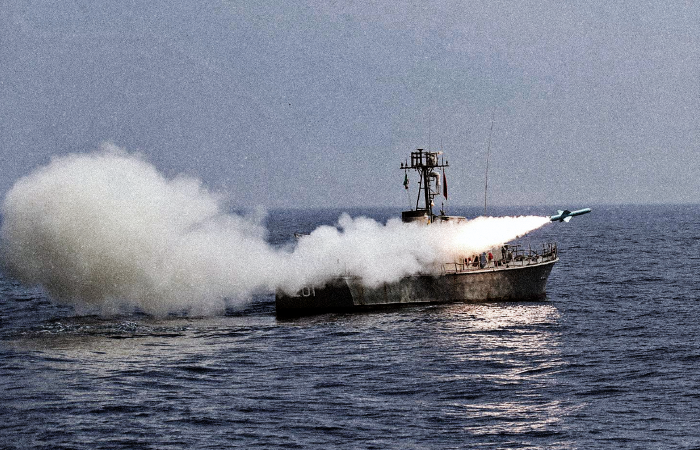
Iran’s IRGCN aims to exploit its enemy’s weaknesses and use its capabilities to succeed in asymmetric warfare.[15] Asymmetric warfare maximizes IRGCN’s survival chance at sea. Thus, the historical lesson from the seventeenth century shows that the “fleet-in-being” strategy allowed weaker navies to challenge stronger ones at sea. [16] Over the past four decades, Iran has constructed its identity as a nation around opposition to the United States, locking it into a protracted geopolitical conflict with Washington.[17] Khamenei has determined that America is the main threat to the Islamic Republic of Iran, and the country’s southeastern coast is considered the most critical counterpoint to the military threats.[18] Iran has developed its naval capacity through land, missile, and drone forces. It uses various tactics in asymmetric warfare, such as suicide boats, guided missiles, attack drones, naval mines, and secret missile bases.
In August 2023, the IRGCN showcased their latest vessels equipped with 600 km missiles during a military exercise in the Persian Gulf. The event included a sea parade with participation from various rocket launchers, helicopters, and unmanned aerial vehicles for intelligence gathering.[19]
In January 2023, the IRGCN conducted an exercise in the Persian Gulf. This exercise used various advanced naval technologies including sea cruise missile systems, drones, and unmanned underwater vessels powered by AI subsurface satellites.[20] The unmanned fast boats are mainly used to monitor enemy movements, fire small and medium-range weapons, launch missiles, and carry out maritime suicide attacks. In April 2010, the IRGCN unveiled “Ya Mahdi,” a new radar evading vessel, during the “Great Prophet Five Exercise.” Sixty high-speed ships and five indigenous cruise missiles targeted a hypothetical enemy warship. [21]
Improving Iran’s Naval Capabilities
According to one estimate, the Iranian naval fleet consists of 400 vessels, seven frigates, three corvettes, 34 submarines, 88 patrol ships, and three mine countermeasures ships.[22] The Navy has been busy constructing various projects such as missile launchers, warships, port facilities, submarines, and support vessels.
In August 2023 Iranian media stated that the IRGC Navy would receive a new generation of Ghadir and Fateh submarines armed with torpedoes and surface-to-surface cruise missiles. The IRGC Naval Combat Organization now has crewless and intelligent submarines, expanding their sub-surface combat capabilities.[23] Iran’s submarine fleet includes Tariq, Noah, Younis, Ghadir, Nahang, and Fatih. Tariq has anti-sonar devices and can carry 18 torpedoes and 24 naval mines. Ghadir can launch torpedoes and missiles, and detect hostile targets. Nahang deploys mines and has anti-ship missile capabilities. Fatih launches and controls cruise missiles and has torpedoes and marine mines.[24]
In July 2023, the Iranian navy received a new sea long-range cruise missile with a range of over 1,000 kilometers called “Abu Mahdi” that is equipped with artificial intelligence to enhance its flight path design and command and control system. This AI technology allows the missile to navigate natural and artificial obstacles and bypass enemy radar and defense sites from various launching directions. With a high-destructive power warhead, Abu Mahdi” can successfully attack and destroy all types of ships, frigates, and destroyers. Furthermore, it can be launched from mobile and stationary carriers, and its navigation system can update the target’s position during flight. Other features include fast reaction time, on-site target selection, and shooting from a distance. Abu Mahdi can fly at low altitudes and adjust its path and altitude based on geographical complications and enemy defense systems, remaining undetected from the enemy’s radar.[25]
In August 2022, Iran’s new “Shahid Soleimani-class ship,” made by the IRGC and Ministry of Defense, arrived in the Persian Gulf with vertical launch silos for defense and anti-ship missiles.[26] The 65-meter-long Shahid Soleimani is a missile corvette that can carry up to three boats and provides protection for high-speed armed boats. It has similar capabilities to Taiwan’s Tuo Chiang-class corvette, using hit-and-run tactics.[27]
Using Naval Proxy Forces
Officials and observers say Iran is now passing on that naval expertise to allied military forces. [28] The United States military must prepare for a potential strategy involving an Iranian proxy fleet. [29] Iran has formed a navy comprised of proxies who share their Shiite political and religious beliefs. This strategy has allowed them to gain influence in Arab communities like Lebanon, Syria, and Yemen. Iran has also enlisted non state actors and official military institutions to create maritime proxies in Iraq. In 2016, the IRGC established its Shiite armed militias as an official force in Iraq. They were organized under a council known as Al-Hashd al Shaabi, or Popular Mobilization Force (PMF). Since 2018, the PMF has created a naval force consisting of special troops, fast combat vessels (Zwalfiqar), and small and medium-sized vessels. [30] These naval militia members are trained to attack naval targets and use missiles against ships stationed at sea. Iran intends for this force to find a spot at the water border between Iraq and Kuwait in the Persian Gulf. [31]
In 2022, reports suggest that Iran’s Quds Force has created a new naval militia, hiring mercenaries from Iraq, Lebanon, Syria, Yemen, and Africa. This group is reportedly trained and equipped to attack ships and maritime targets beyond Iran’s borders. [32]
Building Regional and Global Naval Alliances
Iran is expanding ports and enhancing IRIN vessels to improve maritime relations with Gulf Arab nations, Pakistan, India, South Africa, Latin America, Russia, and China. These relations are driven by trade, security, and conflict with US dominance.
- Iran’s navy has built a new port, Makran, and expanded its operations in the Indian Ocean. Its previous area of operation covered the Persian Gulf and Sea of Oman, but now covers 800000 square Miles. The navy conducts diverse operations such as maritime diplomacy, relief, policing, and military actions.[33]
- Iranian warships Makran and Dena entered the Pacific Ocean for the first time in history, staying in Brazil until March 4, 2023. Their presence in the Panama Canal strengthens Iran’s deterrence and ability to remain in the area, with capabilities including surveillance and suicide drones, airborne missiles, and naval destruction squads.
- Iran has implemented the doctrine of irregular warfare in its navy, which has caught the attention of Russia and China. Since 2019, these three nations have conducted three joint naval exercises. Iran has taken Russia and China to the Persian Gulf, China has taken Russia and Iran to the Atlantic Ocean, and Russia has brought China and Iran to the northern Baltic Sea. It is worth noting that China and Russia are two of the world’s five major players, while Iran is one of the ten Axis countries.
- Recently Iran has been working to strengthen its maritime relationships with African and Latin American countries, India (Alalam 2023), and Pakistan [34]
- Iran is building a naval alliance with Arab states in the Persian Gulf, Strait of Hormuz, and the Arabian Sea, including Saudi Arabia, the UAE, Qatar, Bahrain, and Iraq. [35] China is suspected to be involved in overseeing this initiative. [36]
Outlook
In the Middle East, an Iranian conductor leads a naval orchestra, using conventional power as a background to their asymmetrical warfare notes that aim to deter the US Navy. However, the inconsistent tones of the tools that make up the tactical package allow the United States to take advantage of weaknesses in Iran’s naval strategy. Iran is strengthening its navy, consolidating its forces under a single command, and using asymmetric warfare, diplomatic networks, and maritime proxy groups. The country aims to improve its equipment and vessels. However, these actions could also make them vulnerable to US exploitation.
A report released by the Office of Naval Intelligence in 2009 revealed that Iran’s naval strategy consists of The Moral Component and Political Victory. The Moral Component focuses on the military’s loyalty to the country’s religious regime, promoting resilience, jihad, and martyrdom. The Political Victory component uses different tactics to persuade the enemy’s political leaders that their objectives are unattainable or too costly.
Fast forward fourteen years, and Iran has lost both vital components of its defense strategy.
The Iranian regime struggles to achieve success within its own country. Despite its attempts to secure military victories, the lack of progress in political, economic, and social areas has made it difficult to maintain support from the population. Recent mass demonstrations and lower voter turnout in general elections indicate that relying on political victories and public support is no longer a viable defensive strategy for the Iranian regime.
The situation has escalated to the point where most people are protesting against the government, and the government itself is in a state of “revolution” against the majority. Government employees and university professors, such as Revolutionary Guards Commander Hossein Alaei (the first commander of the IRGCN), have been removed from their positions. Alaei suggests that Iran should engage in direct talks with the United States. These views contrast starkly with the actions of the current Iranian government. Iran’s government lost its moral superiority after the Arab Spring and the battle with ISIS. The Revolutionary Guards struggle to encourage people to fight Sunni jihadist groups without relying on the call to jihad and martyrdom. To combat ISIS outside Iran, the Quds Force was sent, while the Basij forces armed Afghan and Pakistani workers due to job shortages.
Iran’s weakened internal structure has impacted its ability to mobilize proxy groups overseas. The arrival of 3,000 US marines in the Arabian Gulf presents an opportunity for Gulf Arab nations to remove Iranian influence and ensure safety. The Combined Task Force (CTF) should become a regional naval force to mitigate threats and prevent a potential coalition between Iran, Russia, China, and select Arab countries. It is time for the United States to consider building an Arab naval alliance in the Persian Gulf