

By Jada Fraser and Mohammed Soliman
This piece was originally published in Vol. 67, Issue 3 in May 2023.
11 minutes
Over the past two decades, a trend has emerged where US partners and allies look outside of their bilateral relationship with the United States and pre-existing multilateral bodies to join ad-hoc networks. They are joining these networks to both obtain their own security goods and to provide regional public goods. Yet, these ad-hoc networks, or “minilaterals,” often include multiple US allies or shared partners of the United States. For example, the revived Quadrilateral Security Dialogue (Quad) includes Japan, India, Australia, and the United States, encompassing two separate US treaty alliances. Similarly, the tripartite pact AUKUS connects the US-UK transatlantic alliance relationship to the US-Australia alliance in the Indo-Pacific. The newest addition to this growing trend in minilateralism, the I2U2, which redefine the Middle East as West Asia by bringing together the United States, India, Israel, and the United Arab Emirates (UAE), provides additional insight into the benefits of minilaterals as mechanisms for organizing interstate cooperation.
Minilateral groupings have proven adept in responding to challenges and in organizing collective action. [1] Smaller memberships facilitate stronger consensus-building. As minilaterals continue to grow in importance for cooperative action, understanding the opportunities and constraints they offer and how they fit into the broader regional and global landscape is essential.
Minilaterals are proliferating at great speed, especially in the Indo Pacific region. Yet, minilaterals are not a phenomenon unique to the region, and the I2U2—consisting of the United States, India, Israel, and the United Arab Emirates (UAE)—highlights their broad appeal.
The mere existence of the I2U2 group is a gamechanger for the broader Middle East region for several strategic reasons, including: 1) it is the first minilateral created in the region; 2) it is an indicator of the depth of strategic alignment between the UAE and Israel; 3) it showcases how US- India alignment extends beyond the Indo-Pacific; and, 4) most importantly, it signals the end of the “Middle East” and the rise of “West Asia” as a geostrategic concept. [2] I2U2 proves that minilateralism is not limited to the Indo-Pacific and is further evidence that this kind of arrangement is considered an effective mechanism for structuring cooperation. The I2U2 is on the right track to becoming an integral part of regional security architecture, having evolved from an unconventional policy idea proposed by a leaders’ summit in less than a year. [3] I2U2 has signaled it plans to pursue tangible projects that will deliver value to the region and will focus on group cohesiveness. If followed through, this pragmatic agenda would ensure that the group’s longevity extends beyond the terms of its founding members’ heads of state.
In the long term, the I2U2’s own distinct evolutionary story will be influenced largely by regional realities in West Asia, including the lack of both of a unified vision of regional security and an agreed-upon common adversary for the group’s four members. Yet, even with these particulars in mind, two of the main minilaterals in the Indo-Pacific—the Quad and AUKUS—shed light on an up-and-coming player in the increasingly important minilateral space. Moreover, reviewing the Quad’s journey to the present and the promise and pitfalls of the AUKUS model provide important lessons for the I2U2 as it charts its path forward.
The Quad: A Comeback Story
Nearly two decades ago, the leaders of the United States, Japan, Australia, and India convened to address the humanitarian disaster caused by the 2004 Indian Ocean Tsunami and the devastation wrought in countries such as Indonesia. [4] These discussions and the four countries’ experience operating together in humanitarian assistance and disaster relief (HA/DR) response missions laid the groundwork for what is now known as the Quad 1.0. This Quad was formed primarily by former Japanese Prime Minister Abe Shinzo’s advocacy for a greater level of institutionalization. The group eventually died out in 2008 due to a lack of a clear strategic objective—or, rather, the lack of consensus on what that strategic objective should be. The original end goal had been to integrate for a short-term collective response, not to compete for the long term.
However, PM Abe was not deterred from his goal of uniting what he considered the core group of maritime democracies. In advancing his “Indo-Pacific” concept, Abe’s “confluence of the two seas” address to the Indian Parliament in 2007 drew on ideas first articulated by Mughal prince Darah Shikoh, tying his regional vision to its historic roots in Indian strategic circles. [5] Abe’s efforts ultimately succeeded in changing the geopolitical and geographic boundaries of the region, ushering in a conceptual shift from the Asia-Pacific to the Indo-Pacific that brought India into the mix and revitalized the Quad. Australia, too, was quick to see the rationale of this geostrategic framing. In fact, it was the first country to use the term Indo-Pacific in a 2012 government policy paper to frame its broader region. [6] In re-drawing the imaginary lines on the conceptual map, Abe’s Indo-Pacific framing and his concept of a “Democracy Security Diamond” altered the borders of the Asia-Pacific by elevating the geostrategic poles connecting Australia, India, Japan, and the United States in a very real way.[7] Under the Trump administration, Washington fully embraced Abe’s blueprint for a “Free and Open Indo-Pacific” and pivoted its focus toward competing with China and establishing a balance of power that favored a rules-based regional order. Against this backdrop, the Trump administration not only revived the Quad but valued the group’s abilities to help
Washington strike a favorable balance of power in the Indo-Pacific. Yet, importantly, the Quad has chosen to deemphasize the group’s relation to strategic competition with China. Instead, it focuses on the areas of public goods provision that matter most to the region. Such a balancing act is no easy endeavor, especially given the varying security priorities of the Quad members. But this measured approach to hard-security initiatives has played a central role in increasing the Quad’s legitimacy throughout the region.[8]
Much like the Quad’s evolution from a disaster relief arrangement to one that is now perceived as a strategic anchor in the Indo-Pacific security environment, the I2U2 started as an economic-and-tech-focused group without a common vision but is beginning to expand its scope to encompass regional security. [9]
Importantly, the geopolitical reality in the 2000s that led to the Quad’s period of inactivity differs greatly from the global and regional realities in West Asia that the I2U2 currently faces. The Russian invasion of Ukraine, the return of great power competition, the status of Turkey and Iran as transregional powers, and the increasing centrality of Gulf energy to global economic and political stability all necessitate strategic speed from I2U2 in responding to the current international environment and preparing for future regional dynamics.
Understanding the barriers that led to Quad 1.0’s dissolution present important lessons for the I2U2’s understanding of its own potential obstacles. The Quad’s effort to pursue an agenda that considers the constraints imposed by the members’ different security priorities and regional sensitivities offers another important lesson for I2U2. Understanding the potential promises and pitfalls of the AUKUS model unlock important insights into the future of I2U2.
AUKUS: The Necessity of Hard Power
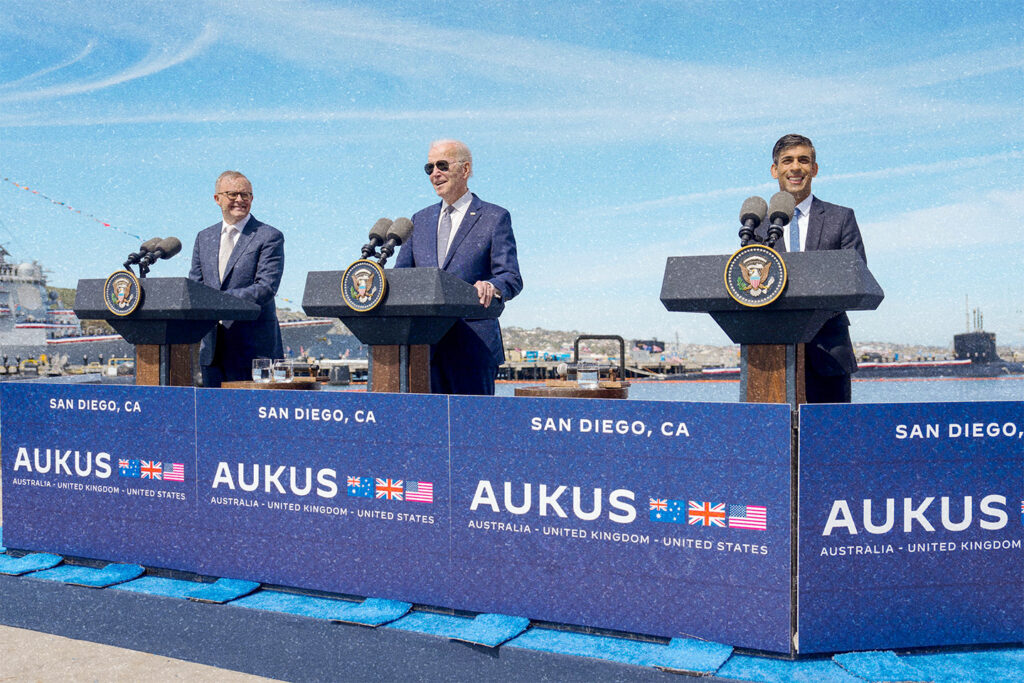
In September 2021, the leaders of Australia, the United Kingdom, and the United States announced a trilateral partnership called AUKUS that centered on defense-technology cooperation. Compared to the Quad, AUKUS is more explicit in its strategic objective: the future delivery of eight nuclear-powered submarines to Australia is aimed at maintaining a favorable military balance of power in the Indo-Pacific. [10] Australia’s potential transformation into a nation with nuclear-powered submarine capabilities reflects the geopolitical realities facing the country. Namely, there is the need to beef up its hard-power capabilities against the backdrop of increased risk of military escalation in the Indo-Pacific.
Much has been written on the significance [11] of the United States sharing nuclear technology—often said to be the “crown jewels” of US military capabilities—for the first time since 1958 [12]. The magnitude of this decision reflects how seriously the three countries view the challenge. However, more than aligned threat perceptions underpin this strategic partnership. The true enabling factor for AUKUS lies in the deep and enduring levels of trust that the three countries share. Forged through decades of operating alongside one another in numerous conflicts, enhanced by a common language and cultural heritage, and founded on a joint vision for a rules-based international order, these “soft” ties facilitated the AUKUS submarine deal as much as, if not more than, “hard” balance-of-power considerations.
Yet, beyond the submarine deal (known as Pillar I of AUKUS), it is Pillar II—which focuses on advanced technologies—that stands to be the real game-changer. [13] Pillar II of AUKUS holds the potential to transform the capacity of states to jointly develop and employ the most cutting-edge advanced capabilities.
The motivations behind Pillar II are several-fold. Perhaps most important is the urgency in responding to a perceived narrowing gap in the AUKUS countries’ lead in the technology race with Beijing. [14] Combining the resources, expertise, and industry of three of the world’s leading countries in artificial intelligence, quantum computing, and undersea capabilities has the potential to exponentially accelerate the US, UK, and Australian abilities to develop, produce, and employ the next generation of advanced technologies.
Yet, the barriers to implementing this level of technology cooperation are monumental. [15] Bureaucratic, budgetary, and technical hurdles in all three of the AUKUS countries, combined with a US export control system that has created obstacles for allies and partners for decades, could render Pillar II obsolete. Some observers deem AUKUS the litmus test for integrated deterrence. The viability of a core concept in the Biden administration’s defense strategy rests on the grouping’s ability to deliver.[16] While the fate of AUKUS remains uncertain, the grouping raises questions about the wisdom of “too big to fail” undertakings.
Beyond these challenges, AUKUS faces a public relations problem in the Indo-Pacific. AUKUS’ inception was marked by a large-scale diplomatic blow-out with France [17] and regional reactions in Southeast Asia to the announcement that ranged from outright condemnation to tepid acceptance.[18] The more recent AUKUS progress announcement on March 13 elicited a second round of regional denouncements, including Jakarta’s assertion that it will push to refuse access to the AUKUS subs. [19] Moreover, proliferation concerns surrounding AUKUS remain persistent and are exacerbated by Beijing’s disinformation campaign.[20]
The grouping has suffered from a lack of narrative building. AUKUS tells a cautionary tale on the importance of effective diplomacy in dispelling misinformation and building a narrative sensitive to regional apprehensions of hard-security initiatives. It also holds the promise of creating a first-of-its-kind defense-technology ecosystem that takes collaboration and interoperability in advanced technologies to a new level.[21] I2U2 would be well-served by learning from AUKUS’ ongoing navigation of opportunities and challenges and adopting similar best practices where it can.
From the Indo-Pacific to West Asia
Rather than viewing the Quad and AUKUS in isolation, if understood collectively, both groups add complementary value to the region. When viewed as part of a network of minilaterals, rather than introducing discord and dysfunction, AUKUS and the Quad add reinforcing support to the Indo-Pacific security architecture. The Quad’s focus on public goods provision is matched by AUKUS’ contribution to military balance of power. The makeup of each minilateral’s membership largely shaped this division of roles between the Quad and AUKUS. For the I2U2 to be successful, it will need to build an agenda based on both the opportunities and constraints that its membership entails.
In the West Asia region, India, Israel, and the UAE face similar realities of regional instability, an increase in non-state actor activities, and limited American strategic bandwidth resulting from both its strategic pivot to Asia and the Russian invasion of Ukraine. Like the Quad, and given the need for strategic speed, the I2U2 is likely to continue pursuing a policy that avoids antagonizing regional powers and, focusing on bottom-up organizational development that centers on food security and climate initiatives, with room for expansion to cyber and tech. However, amid the growing threats posed by Iranian drones and missiles, Israel and India reportedly deployed Barak 8, [22] a co-produced air defense system, to the UAE.[23] For Israel, this move looks like a stepping stone toward its objective of building a regionally integrated air defense system.[24] But the deployment of the Barak 8 also represented a fast change to the I2U2’s nature. By pursuing a common defense project, focused on meeting the urgent desires of participating nations for improved air defense capabilities, the I2U2 once again shifted away from its soft-power roots in favor of expanding its regional hard-security activities. In a complex region such as the Middle East, I2U2 is proving that minilaterals are especially adept and flexible in responding to rapidly changing geopolitical environments.
The Future of Minilaterals
During the Cold War, two organizations dominated the geopolitical landscape. The US-led NATO and the Soviet Union–led Warsaw Pact were the main vehicles used in achieving both groupings’ strategic objectives. These formats’ effectiveness rested on closing ranks within the two organizations’ member states to decrease room for dissent. Even after the Cold War ended, NATO remained a core alliance for the United States despite its global primacy. Today, the end of the unipolar moment— combined with an emerging era of global disorder marked by the great power competition between the United States and the China-Russia axis— is fundamentally changing the geopolitical map. The ensuing strategic environment has created a need for new formats that incorporate the national interests of middle and regional powers. The Quad, AUKUS, and I2U2 represent prime examples of minilateral formats capable of effectively navigating these changing regional and global dynamics. They offer important lessons for other minilaterals that might not include the United States, such as the France India-UAE trilateral and the Australia-India-Indonesia trilateral.