
31 minutes
Image credit
One way in which America is exceptional—its geographic situation—has conditioned its foreign policy in under appreciated ways. What has driven much of American foreign policy historically is a desire to preserve their democracy rather than spread it to others, which was thought to require avoiding a competitive security environment that would erode democracy. Changes in technology in the 20th century changed the perceived effects of geography. American involvement in the World Wars was not because their security was directly threatened, but because it threatened to place them in a competitive security environment. But Cold War pressures created the national security state, and although American geographical uniqueness remains, much of the traditional concern of a competitive security environment has attenuated. American exceptionalism in this sense diminished when talk of American exceptionalism became widespread. But geography still invites Americans to reassess the order they created.
“American exceptionalism” is a phrase and concept increasingly used in American political discourse and discussed among scholars. One of the oddities of the discussion about American exceptionalism is the polarization between scholars and politicians on the topic. American politicians usually insist America is exceptional and can get into trouble when they suggest otherwise.[1] Scholars, on the other hand, mostly dismiss the notion that America is exceptional. Another oddity of the discussion of American exceptionalism is the lack of clarity over what the concept means. Whole books are written on the topic without defining the term. Alexis de Tocqueville and Ronald Reagan are lumped together as if they were talking about the same thing.
A starting point in understanding American exceptionalism is that there are multiple meanings of the concept. An implication of this is that when scholars denounce the concept wholesale, they are getting ahead of themselves. In contemporary political discourse, American exceptionalism seems often to be used as a synonym for American greatness.[2] Many scholars may not share this normative assessment, which is often, though not necessarily, associated with a politically conservative perspective.[3] That is one reason why some scholars dismiss America as exceptional. But there is a positivist meaning to the term. To be an exception is to be an outlier, to be different from the standard set of cases. De Tocqueville said that America was in an “exceptional situation” that generated an interest in the practical rather than science, literature, or art that was not inherent in democratic societies.[4] American communists used the phrase “American exceptionalism” in the interwar period in their debate with Joseph Stalin over whether the unique capitalist development of the United States would stave off a communist revolution. Both were not approving of American exceptionalism but were noting that it was different.
There are a variety of ways in which the United States may or may not be an exception compared to its peers. Discussions of American exceptionalism have involved America’s domestic traits, such as the lack of a robust socialist party,[5] but also its foreign policy. Some consider American exceptionalism in the context of foreign policy to mean that traditional constraints do not apply to Americans.[6] A more popular meaning is that America is a unique force for good.[7] A more specific version of that is that the United States is unique in its attempt to export democracy abroad.[8] But America’s supposed democracy promotion is not what made them exceptional. Democracy promotion in fact has not been a hallmark of American foreign policy for much of its history, and the reason why points to one way it is truly exceptional.
My argument is that one difference the United States has had with its peers, an undeniable exception, has been its geography. By peers, I mean the European states and European state system that the United States descended from and was compared with. By geography, I mean that the United States was founded on a continent that was relatively underpopulated and for the most part had weak or disinterested neighbors. This geographical situation was not like other European states and is arguably the root for a variety of ways in which America has been exceptional.[9] It certainly conditioned American foreign policy. Discussions of American exceptionalism usually involve America’s liberal democratic system. That is a part of the story of American exceptionalism in their foreign policy, but it is how the needs of that democratic system met with America’s exceptional geography that conditioned its foreign policy. The United States has attempted to create a threat free environment, seen as necessary for its democracy, and possible given its exceptional geography.
Founding Themes of Non-Entanglement, Unionism, and Expansionism: Building an Exceptional Geography
The founders of the United States considered that one of the potential threats to their democratic system was the threat to personal liberties from a powerful state. Powerful states necessarily arose from competitive security environments. Long before Charles Tilly’s pithy phrase about state formation, that “war made the state and state made war,” the founders understood this basic notion and tried to create a state system that did not look like the competitive security environment they saw across the ocean. It was not just war, but the threat of war that threatened republican institutions, because even the threat of war would require large standing armies and a strong state that would curtail liberties. With it would come conscription, taxes, debt, and increasing power to the executive. Thus, the goal was not just protecting the homeland from invasion; it was the elimination of threats. This is a common theme in the history of American foreign policy—not just managing threats, but eliminating them, which was what they saw as necessary to create an environment where their liberal republic could thrive.
There were three basic policies enacted to prevent a competitive security environment from developing on the North American continent: non-entanglement, unionism, and expansionism. “Non-entanglement” is a more preferable term than “isolationism,” which has been used to characterize American foreign policy prior to its sustained global leadership from World War II onward.[10] Isolationism has lost favor among many because it seems to suggest a turtle withdrawn in its shell, even though, from the American founding onward, there was a dense network of trade and other connections in the “Atlantic world” and other places, and America was aggressively expanding across the continent.[11] The truth about isolationism is the non-entanglement part. What many have meant when they characterized American policy as isolationist is that the United States did not want to become embroiled in the game of European great power diplomacy, which involved alliances, war, and the threat of war. Of course, it was only their playing the game of European politics that had won their independence in the first place, but with that secured, they wanted to get out of it. As George Washington famously proclaimed in his Farewell Address, “the great rule of conduct for us in regard to foreign nations is in extending our commercial relations, to have with them as little political connection as possible.” Washington was aware such a policy was only possible given their “peculiar” “detached and distant” situation.[12] Their geographical remoteness allowed them to avoid what Jefferson and others called “entangling alliances” for well over a century. The United States was for the most part a negligible factor in European diplomatic calculations into the 20th century.
America’s non-engagement approach is illustrated in their lack of democracy promotion. Oftentimes revolutionary states have not only the altruistic missionary desire to evangelize, but the interest of spreading their political system from the fear that if they do not make converts, they will be squashed. The United States, because of its isolated position, could afford to develop their own system without interfering in European politics, and indeed there was a notion that interfering in European politics would threaten democracy at home. Thus, as John Quincy Adams famously said, responding to requests that the United States support liberal revolutions in Europe: “Wherever the standard of freedom and independence has been or shall be unfurled, there will her heart, her benedictions and her prayers be. But she goes not abroad in search of monsters to destroy. She is the well-wisher to the freedom and independence of all. She is the champion and vindicator only of her own.”[13] It was not democracy promotion, it was preserving democracy at home that motivated them, which favored a non-engagement policy.[14]
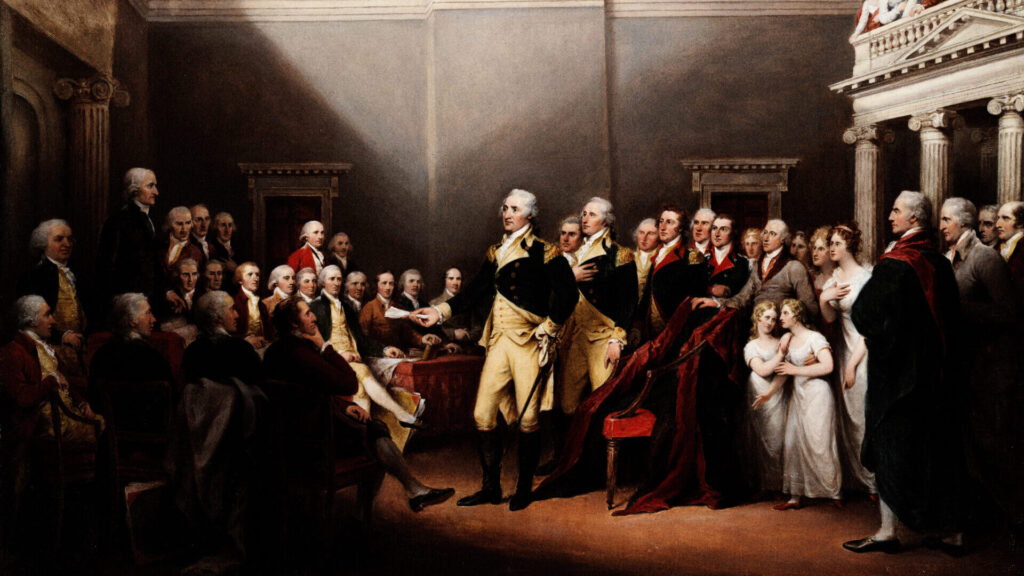
While Washington’s admonition to steer clear of permanent alliances in his Farewell Address is well known, a major topic of that address was unionism. This is the second policy of preventing a competitive security environment that would endanger liberty: keeping the states together in their federal compact. “What is of inestimable value! They must derive from Union an exemption from those broils and Wars between themselves, which so frequently afflict neighboring countries … hence likewise they will avoid the necessity of those overgrown Military establishments, which under any form of Government are inauspicious to liberty, and which are to be regarded as particularly hostile to Republican Liberty.”[15] Given America’s distance from Europe, it was obvious even at the outset of the Republic, when there were thirteen states clinging to the shores of the Atlantic, that their biggest obstacle to avoiding a competitive security environment was themselves. That was one critical reason why there was a move from the Articles of Confederation to the federal system enacted by the Constitution—it was a more effective arms control treaty between states than the Articles of Confederation.[16] As Alexander Hamilton laid out in Federalist #8, Europe was too far away to pose a threat and thus the need for “extensive military establishments.” But if the union broke up, “we should be, in a short course of time, in the predicament of the continental powers of Europe—our liberties would be a prey to the means of defending ourselves against the ambition and jealousy of each other.”[17]
The fact that the Union would persevere was by no means clear at the time, and our hindsight bias sometimes writes this factor out of history. For example, it is not commonly known that what propelled Jefferson to acquire New Orleans and the Louisiana Territory was less that he feared France threatening the United States or that the United States would be restrained from growing beyond the Mississippi than it helped ensure the “durability of the union”—meaning that the territory to the west of the Appalachians, oriented toward the Mississippi, would not break from the Atlantic states.[18] Also relatively forgotten is when the Junto Federalist party in New England was considering breaking away from the Union, which prompted John Quincy Adams to warn that if that party was not put down, “Instead of a nation, coextensive with the North American continent, destined by God and nature to be the most populous and most powerful people ever combined under one social compact, we shall have an endless multitude of little insignificant clans and tribes at eternal war with one another for a rock, or a fish pond, the sport and fable of European masters and oppressors.”[19]
The biggest threat to the Union was succession of the Confederate states, which precipitated the Civil War. Of all the literature on the origins of the conflict, most of it focuses on the causes of secession. While slavery was the reason the South seceded, that does not explain why there was war, because the North could have let them go. War was initiated by the North to force the South back into the Union.[20] Why were they so committed to the Union? The logic in Federalist #8 was rarely spelled out. More often there was a general notion that succession would lead to anarchy and the dissolution of democratic government, as Abraham Lincoln expressed in his inaugural address. The geopolitical effects of the Union breaking up was present, but not on the top of most people’s minds.
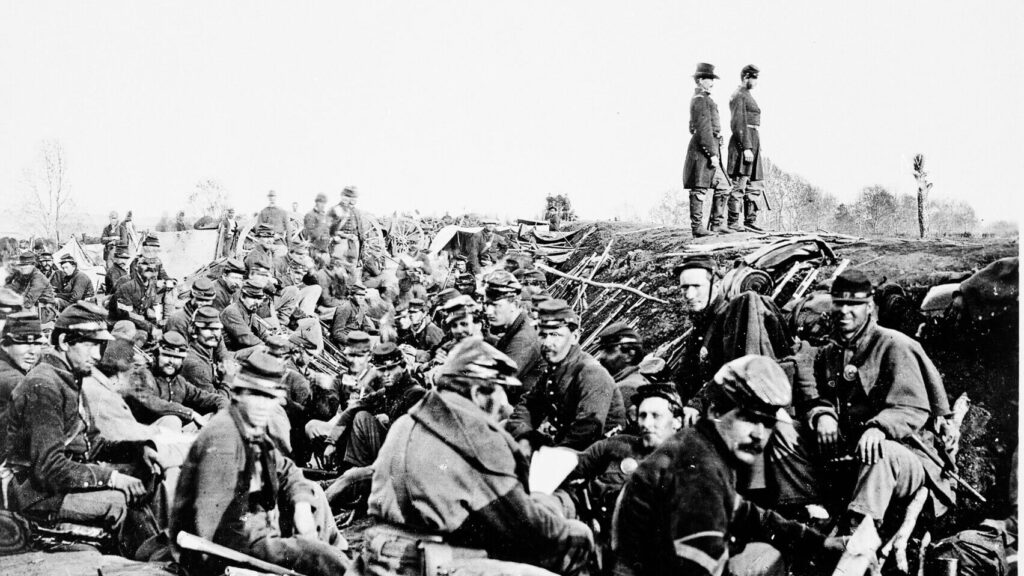
In fact, the Civil War exhibited American fears of a competitive security environment, in this case two rivaling great powers on the North American continent, increasing the power of the state, which would encroach liberty. Lincoln, among other things, suspended habeas corpus rights. The Confederates, who regarded a decentralized federal system as essential to their conception of freedom, were forced through the war to build up a powerful centralized state.[21] Outside observers, assuming the North would be unsuccessful in its aim to conquer the South, predicted a new era of strong states with powerful militaries.[22] Instead, the North won and then rapidly demobilized the largest army in the world.
America is referred to as having “free security” for much of its history on account of its geographic situation.[23] It is true that their geographic position has uniquely protected them, but they still had to worry about themselves. There was nothing free about having to wage one of the largest wars in the world in the century between the Napoleonic Wars and World War I.
The flip side of unionism was expansionism. If one did not want a competitive security environment developing in North America, then one not only needed to make sure that the federal union did not break up, but that it expanded to dominate the continent. The United States had an exceptional geographical setting. There was a vast land before it, resource rich and lightly populated. As de Tocqueville said, the Americans “have fallen on a new and unbound country in which they could spread out at will and which they could make fertile without difficulty. That is something without parallel elsewhere in the world.”[24] Scholarship has shown that the pre-Columbian population of the Americas was substantial—much greater than previously thought.[25] But there is no question that by the time of the American founding, the lands to the west of the Eastern seaboard were by no means uninhabited, but lightly populated, especially because of the diseases that had decimated the native population.[26] The indigenous inhabitants were thus easily overrun. Besides indigenous peoples, the United States either faced very weak neighbors (the Spanish Empire and Mexico, both of which ruled much of their northern reaches in name only) or neighbors (the British and the French) that were not particularly concerned with containing American expansion.[27] What this meant is that the United States could expand and keep the state weak. Indeed, expansion was a substitute for state building, in contrast to the situation in Europe. For example, while the Prussians required what was described as a military with a state rather than a state with a military for its expansion, the United States in the nineteenth century has been described as being “stateless” in comparison to European states. Its most significant act of conquest (the Mexican-American War) was accomplished with a relatively small army, largely consisting of hastily mobilized volunteers. The single greatest expansion was accomplished by negotiation: Thomas Jefferson’s purchase of the Louisiana Territory.
Some have considered Jefferson’s phrase, “empire of liberty,” to be contradictory—the demands of empire were in competition with the demands of liberty. But Jefferson used that phrase interchangeably with “empire for liberty.” The federal system needed to be expansive to prevent a competitive security environment to preserve liberty. One of the most innovative political philosophy ideas of Americans was to turn the thinking about republics—that they had to be small to succeed—on its head.[28] This was not the only motive for expansion, and the federal government was not the only actor in at least setting the stage for expansion, but it was one of the motives, and one that was often in the background: more explicit at beginning and then often an unquestioned assumption.
Why then did the United States not expand further? It was not because of the constraints of outside powers. In fact, outside powers expected the United States to expand more than they did.[29] Much of their limitations were because of their domestic political system and racism. The issue of the balance between states supportive and in opposition to slavery constrained expansion prior to the Civil War,[30] as well as the fact that the United States had claimed most of the relatively underpopulated land they could overrun. They could not incorporate more of Mexico in the Mexican-American War, for example, without taking more populous areas, and because Americans believed Mexicans were not capable of self-government, they could not be admitted into the republican system.[31] Thus, while racism was a means for empire in Europe—it justified European domination over other societies—to some extent it was the opposite in the United States: racism hindered empire.
Still, the United States had as much land as they needed to dominate North America and indeed had the capacity to figure large in the diplomatic calculations of the great powers, had they chosen to do so. But even given the American participation in imperialism particularly surrounding the Spanish American War, such as their rule over the Philippines, they for the most part chose not to involve themselves in European great power politics, following the old dictums of non-entanglement. An illustration of that non-entanglement is the fact that, in the run up to World War I, the United States did not register in diplomatic calculations of European powers, despite it being the largest industrial power in the world, and despite the Americans’ critical role in ending the conflict.
The World Wars and America’s Exceptional Geography
World War I would bring to the fore American power on the world stage, as well as the debate over whether the American’s exceptional geographical position no longer sufficiently protected them from threats given technological changes. As America debated involving themselves in World War I, the largest camp were the “pacifists,” or what might now be called “isolationists.” Second biggest were the “liberal internationalists,” those that argued the United States could no longer keep itself from entangling with European powers, so it needed to transform the European great power political system away from a competitive security environment just as had been done in North America so that America’s freedoms could be preserved. These camps, then, had similar motives, just different tactics. Woodrow Wilson, who shifted from the former to the latter camp, said he wanted to make the world safe for democracy, and he meant particularly American democracy. What type of international environment would preserve American democracy? A non-threatening one, and in Wilson’s perspective, a system governed by law and justice rather than competitive balance of power politics. Wilson stated at the outset of the war that if German militarism prevailed on the Continent, “We shall be forced to take such measures of defense here as would be fatal to our form of government and American ideals.”[32] This would be the same sentiment of Franklin Roosevelt in the American entry into World War II.
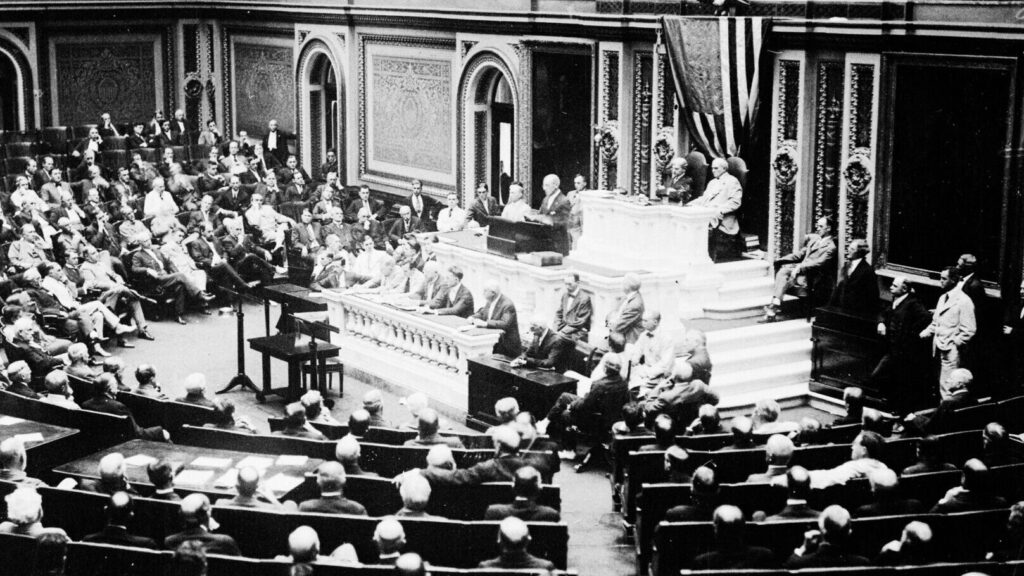
In the aftermath of World War I, the United States rapidly demobilized and refused to join the League of Nations. Scholars have pushed back on the characterization of American policy of this period as a return to isolationism,[33] and it is true that this term (which was created in this period by internationalists to caricature their rivals) distorts more than it elucidates. The United States was engaged in affairs on the European continent like never before. But the truth in it is that the United States was still not willing to militarily commit themselves to the defense of the international order. The Dawes Plan, for example, which loaned money to Germany to diffuse the crisis brought on by Germany defaulting on reparations payments and the subsequent French and Belgian occupation of the Ruhr, was a significant act of American diplomatic involvement, but it signaled that the French were on their own in terms of protection from Germany. What could have stabilized European order would have been an explicit American military alliance with France. But it is not surprising that the United States did not pursue such a policy. It would have been inconsistent with traditional American practices and contrary to why the United States had entered the war in the first place.[34] They were still heading Washington’s call to extend commercial relations with as little political connection as possible.
As the Nazi threat rose, there again emerged camps about American policy toward Europe that paralleled the positions in the debate over the First World War. The two most important camps—variously called the isolationists, pacifists or “Europhobic hemispherists” and the liberal internationalists or “Hullian liberals”[35]—again had the same goals of preserving a world in which the United States was not involved in a competitive security environment, but had different means: whether to transform the system or stay out of it. The so-called isolationists held considerable sway given that was the traditional policy of the United States, and the direct threat from Nazi Germany was not obvious. There is debate over whether Adolf Hitler was a continentalist who aimed to conquer just Europe or a globalist who aimed to conquer the world. His eventual ambitions towards the United States were not clear. But even if Hitler had globalist ambitions, he did not have the capabilities to act on them. Even if he was able to conquer and maintain control of Europe—a big if—there is good reason to be skeptical that this would give him the capabilities to conquer the North American continent.[36] But this was beside the point for policymakers in the Roosevelt administration. It was not so much the physical invasion of Germany that they feared, but the consequences of the peace they would have to live with. To defend the United States against the Nazi empire they would have to become a garrison state.[37] They could successfully deter German invasion, but in the process would be forced to give up their liberties. Many thus turned from Europhobic hemispherists to liberal internationalists, who hoped to remake world order.
At the same time as the Roosevelt administration was contemplating war, American scholars were inventing the phrase “national security” and were defining it in peculiarly American ways. At a seminar on the eve of American entry into World War II, the definitions included not just a defense of the territory or sovereignty of the United States, but its “core values.” Albert Weinberg, a scholar of manifest destiny and isolationism, provided the group’s working definition: “National security is the condition in which external attack, direct or indirect, by armed force or other means, upon the nation’s territorial domestic, rights, or vital interests is not likely to be made or, if made, to succeed.”[38] This is not the definition Polish policymakers would arrive at. But it was consistent with traditional American thinking on security matters—their wanting to live in a threat free environment—and a function of their exceptional geography.
The Age of Permanent Threats and American Foreign Policy
Although sometimes forgotten given subsequent developments, the United States after World War II wanted its military to largely demobilize and to have its international security commitments minimalized. While a recent work has argued that the United States settled on world empire in the early days of World War II,[39] this was far from settled, and would drive a good part of the instability of the early Cold War. The United States emerged from the war in a position of unprecedented power—having half the manufacturing production of the planet, a nuclear monopoly, and a massive military machine. But that military machine was being rapidly dismantled in the aftermath of World War II, which aligned not only with traditional American postwar patterns, but the very aims of getting into the war in the first place. They fought to prevent the necessity of a large military state. Having solved the Nazi problem in Europe, American policymakers now faced a potential Soviet hegemon, from what they felt was a position of weakness.[40] Since it was assumed in the Truman and Eisenhower administrations that the United States would not have a large military presence in Europe because it was inconsistent with American values, the logical consequence was for Western Europe (and Germany in particular) to rearm, including nuclear weapons. This raised the ire of the Soviet Union.[41] As was the case in the aftermath of World War I, the American tradition in foreign policy, forged in the context of America’s exceptional geography, had it pulling back from commitments to Europe, which had destabilizing results.
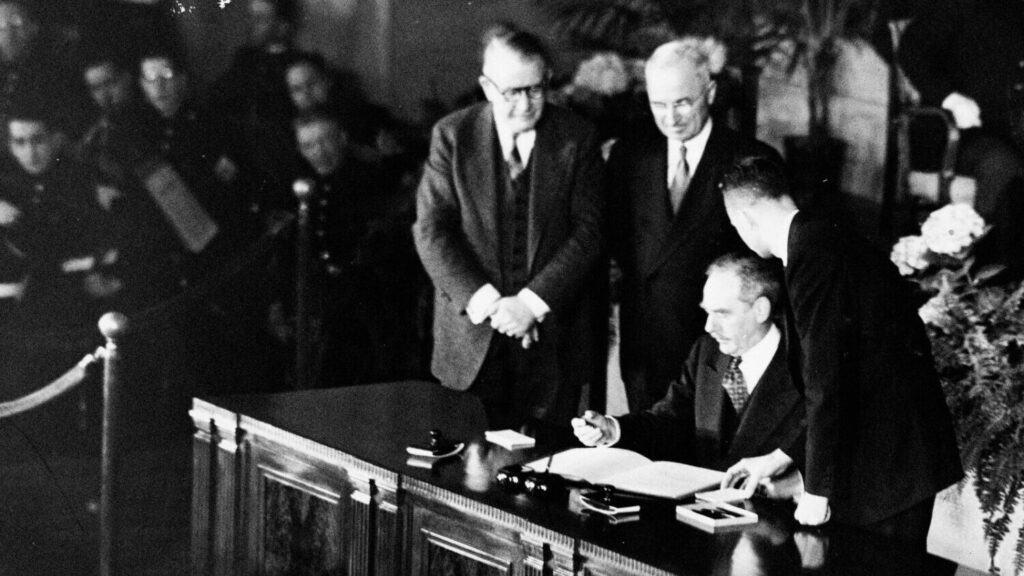
Eventually, however, the United States departed from its tradition given the pressures of the Cold War. Beyond the creation of the North Atlantic Treaty Organization (NATO) and other alliances, there also would be a significant permanent military presence in Europe and in East Asia. In Europe, Dwight Eisenhower had pushed for a European Defense Community because he did not see a permanent American military presence as viable. It was not viable in good measure because it was seen as dangerous for American democracy. There was extensive concern among American policymakers in the early Cold War of creating a garrison state.[42] Eisenhower’s reliance on “massive retaliation” and nuclear sharing with allies was in part a product of trying to avoid such an outcome. But policymakers could not sort out a viable alternative to American power. They created the modern national security state, along with the imperial presidency, and settled into permanent American military commitments.
When the Cold War ended, there was an expectation that Americans would again largely retreat to their home. Debates on the future of Europe by international relations scholars were premised on the notion that the United States would be militarily withdrawing from that region.[43] This did not happen. In fact, American global military commitments and presence expanded. The size and spending on the military were reduced, but what is surprising is why those cuts were not deeper, given that the reason the military machine had been built up collapsed and given traditional American concerns.
Why was this the case? Many factors can be cited. Patrick Porter argues that it was America’s dominant position and the habits of empire.[44] American officials often pointed to the threat environment, arguing that an American presence prevented threats from emerging, or was needed to handle new threats. In the tradition of eliminating threats rather than managing them, after 9/11 the Bush administration declared a war on terror instead of a limited police action. And, more recently, threats from Russia and China became more salient.
Another reason there was not significant retrenchment after the Cold War is that Americans had learned to live with a national security state and their informal empire. The fears that had driven policymakers to avoid it had not materialized or at least were deemed to be manageable. Democracy managed to persist, and at any rate, the drains of the military had become less and more indirect. Military spending was no longer as large a part of the government’s budget in the era of the welfare state, and politicians had means to hide the costs.[45] Soldiers were no longer drafted and were a small percentage of the population. The United States found that it could maintain hegemony on the cheap, relatively, and its democratic institutions could persist. Americans still had unique (or exceptional) antistatist beliefs in some areas, such as gun control. But it no longer extended into military affairs. In fact, there was a role reversal. The distinction may not be as stark as one commentator wrote in the run up to the American invasion of Iraq: “Americans are from Mars and Europeans are from Venus.”[46] But gone were the days when the United States contrasted with the Europeans in their fear of a powerful military establishment.

If that part of exceptionalism was no longer salient, the geography of America still was and is. Even given the nuclear age, American geography is unique in the protection it affords it. This is a weapon for those arguing against the notion that threats require an active presence abroad. Some international relations scholars point to America’s geographic invulnerability and advocate a grand strategy of restraint, but from a position of realism rather than traditional democratic concerns.[47] There have been persistent concerns by libertarians, leftists and others that sound like the traditional concerns of American policymakers: that the American empire has a blowback effect on civil liberties at home.[48] The libertarian right and the anti-imperialist left, though, are not a robust coalition. And the concerns to preserve American democracy at home can be marshaled for an argument to keep America engaged in the world, to keep the world safe for democracy. But the geographic exceptionalism of the United States that makes them relatively invulnerable is a counterweight to threat-based arguments, and if that argument is neutralized, an argument for an American-led order based on habit is a vulnerable one, one that could be toppled by someone who does not respect that tradition.
The increasing calls for a pull back from the American led order do not derive from the influence of academic realists or the traditional fears of a national security state. It is largely headquartered in the Republican party, where there are radical ideas about unravelling the administrative state. But this usually does not extend to the Department of Defense. The call to return to the views of the founders does not include their fears of standing armies. Instead, the recent calls by Republicans for America to reduce its overseas commitments seems largely driven by Donald Trump. One of his few longstanding foreign policy beliefs is that American allies have been ripping the United States off. Beyond Trump, though, the relative decline in American power combined with their invulnerability will make it more difficult to sustain American leadership at post-Cold War levels. Perhaps America’s persistent inclination toward threat inflation, or as John Thompson has put it, the “exaggeration of American vulnerability,”[49] will sustain American engagement. Or perhaps it will be their desire to live in a threat free environment by dominating it. They may decide that an American engagement preserves their way of life. Or perhaps emerging threats especially from their biggest geopolitical rival, China, will sustain American engagement. But the threat from China will always be more abstract to the United States than Japan, let alone Taiwan. This makes their engagement more of a choice for Americans and leaves the possibility of a significant pullback. And if there is, it will be more difficult to reengage, given its geography.[50] While geography affords protection to the United States, by making Americans less willing to uphold world order because they seem to have less at stake, it can undermine the system that America (and the world) has benefitted from.
Some argue that states do not uphold an international system but rather pursue their narrow self-interests. But it has been done, and it works best when there is a sharp sense of threat that reinforces how upholding a system is in one’s interest.[51] This was hard for the United States given their tradition and their geography. It took not just two world wars, but the emergence of a Soviet geopolitical and ideological threat to rope the Americans into a larger project of upholding an American-led order. But now that commitment is unravelling, and one basic reason is because the threats to America are more abstract, given its geography. In this sense, geopolitics is the root cause of changes we are seeing in the American led order.
Persistent and Passé Exceptionalisms
One scholar has claimed that a “geopolitical perspective on American empire represents an emphatic rejection of American exceptionalism. It is no longer possible to think of the Revolution as a fork in the road when the founders wisely chose a unique path to the future that would set the United States apart from the rest of the world.”[52] I disagree. A geopolitical perspective represents an emphatic confirmation of American exceptionalism. America’s geographic situation has not looked like any other great power. This has allowed the United States to become the world’s only regional hegemon not in spite of the fact that it is a democracy, but because it is a democracy. While the founders did not use the term “exceptionalism” and “exceptional,” when they discussed the uniqueness of the United States, it was not the moral superiority of its people, but its unique institutions (at the time) and its unique geography. They thought there was a relationship between the two. The United States is no longer unique in terms of democracy, although a federal union that encompasses a continent is somewhat unique (depending on the future of the European project), and it is product of a vision, a vision that was possible because of peculiar geographical circumstances.
At its founding, the United States had geographical advantages that were exceptional from the European great powers. It had weak or indifferent neighbors on an underpopulated continent. But to preserve a threat free environment, they had to dominate the continent (become a hegemon) and not split apart. They did this. That vision, carried into the 20th century, affected how the United States chose to enter into the World Wars, with decisive results. It also was driving the American desire to withdraw itself from the European Continent after those wars, which undermined the Versailles settlement and destabilized the Cold War until the United States accepted that they would provide a permanent military presence in Europe.
Ironically, the talk about American exceptionalism has blossomed when the United States is not as exceptional as it was in terms of avoiding a powerful military establishment. Its geography is still unique, and although it does not protect America from threats as much as it used to given technological developments, the United States is relatively invulnerable. American fears of a competitive security environment eroding American democracy by the traditional means—creating a powerful state that saps American freedoms—has largely attenuated. One thing that has persisted is the American penchant for eliminating threats rather than managing them. This was on display during the war on terror when that penchant, and American preponderance, prompted hubristic aims to transform the broader Middle East. Both the grand strategies of primacy and (neo)isolationism, or a variant, the sphere of influence model, reflect that disposition to dominate the world or be done with it, rather than uneasily living in a world it does not dominate. Despite our interconnected world, geography allows a reassessment of American commitments, and we are now at the beginning stage of this reassessment.