

Everything Old Is New Again
7 minutes
When Robert Strausz-Hupé launched Orbis in 1957, World War II had only been over for 12 years and the West had to process the trauma of the “fall” of Eastern Europe and China to communism while preparing itself for defense against the threat of nuclear war. It was also only four years since the unsatisfying stalemate of the Korean War, which suggested that the Cold War was no temporary aberration but likely to endure as the defining feature of international affairs for the foreseeable future.
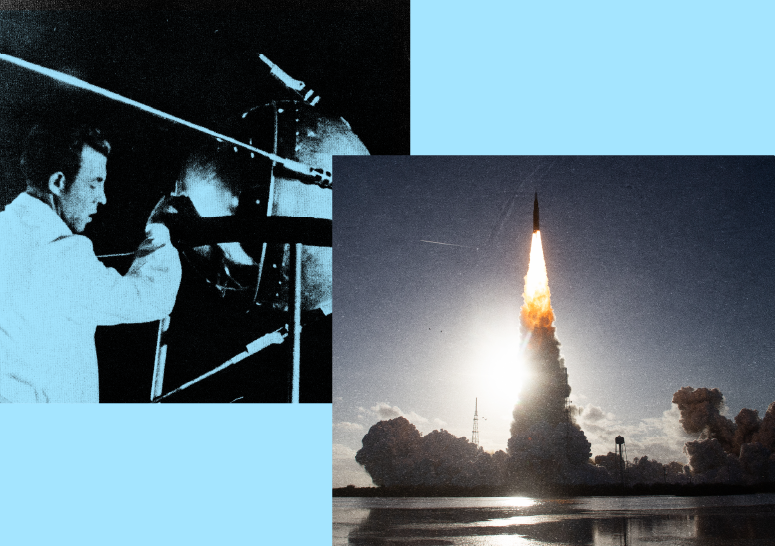
Meanwhile, technological advances promised both boon and bane. The thermonuclear revolution was well underway,[1] opening the possibility that human beings would have the capacity to destroy the species several times over, but major jumps in medical science (from penicillin to advances in trauma care) made, for the first time in human history, combat operations much more survivable. In the year of Orbis’ founding, the launch of Sputnik I warned that no spot on the Earth’s surface would be safe from attack while also opening the gateway to the heavens. Another milestone, three years after the journal began publication, was the creation of the first operational semiconductor integrated circuit—the basis of the modern computing revolution that has so transformed our entire lives.
But the journal appeared only months after the twin crises of 1956: Suez and Hungary. One threatened to shatter the Western alliance and the other solidified the division of Europe. While the Western powers were in the throes of decolonization, the Soviet Union seemed poised to make inroads in regions that had been vacated. Strausz-Hupé concluded that “the West was not winning the Cold War and its technical lead … was being fiercely challenged by Soviet achievements.”[2] Moreover, he believed that the existing outlets were not asking the right questions and were too enthralled by “backward-looking ideologies.”
In the same year as Orbis began publication, Henry Kissinger published Nuclear Weapons and Foreign Policy, his effort to provide a new theory of how to wield power in the international system in light of the reality of nuclear weapons.It was in this environment of geopolitical rivalry and technological transformation that Strausz-Hupé launched Orbis because, as he wrote in the inaugural editorial, “The salient characteristic of a revolutionary age is the precariousness of institutions and associations.”[3] An appeal to past precedents or any effort to “restore” a previous status quo in world affairs was doomed to fail because “the pace of technological and scientific development imparts to politics an acceleration for which there is no precedent in history.”[4] Understanding how international affairs were driven by the dynamic interplay between geopolitics and technology would be critical for policymakers to craft successful strategies for coping with these changed conditions.
In words that seem to echo our current predicaments, he wrote, “The United States has many and mostly intelligent policies for coping with all kinds of current crisis situations, but it has not a coherent vision of the future, its own and that of mankind.”[5] He called on US policymakers to understand and utilize the tools of what he termed “federative power”—the ability to generate positive connections using all tools of statecraft to bring together countries in common cause—where American economic and technological power, in particular, could be deployed in a “partnership to mutual advantage.”[6]
Orbis was created at the dawn of the Third Industrial Revolution and in the midst of the Cold War. Sixty-nine years later, we now stand at the threshold of a Fourth Industrial Revolution which is proving to be just as revolutionary and unpredictable in its effects on society, politics, economics, cyber warfare and the battlefield.[7] A chaotic and unpredictable international environment is characterized by renewed rivalries between major powers exists today, where technology has shrunk decision time, blurred the balance of offense defense, and added more uncertainty.
Towards the end of his life and career, Strausz-Hupé expressed concerns about the impact of demographic, technological, and ecological challenges on the conduct of geopolitics.[8] Two decades later, his musings have proven correct as countries struggle to ensure the health, energy, economic, and technological security of their societies, and the geographic dimension of national security increasingly is viewed in terms of supply chains, natural resource deposits, and industrial centers.[9]
But why relaunch and refocus Orbis? Because a refresh is very much in the intellectual tradition of Strausz-Hupé, who in the last years of his life eschewed a recapitulation of his past writings because “the new world is fundamentally different.”[10] The mission of the relaunched Orbis is to the bridge the gap between scholarship and policy by asking strategic questions, interpreting technological change, and examining emerging geopolitical competition. Yet, the purpose of Orbis remains what it was in 1957: to help scholars, policymakers, and practitioners understand a world where power, technology, and political order are constantly being reshaped.
This issue contains two sections that relate closely to the vast changes taking place in the international system and America’s role in it—in keeping with Strausz-Hupé’s charge.
“This issue contains two sections that relate closely to the vast changes taking place in the international system and America’s role in it—in keeping with Strausz-Hupé’s charge.”
The first section of this inaugural issue presents three perspectives that converge around the relationship between emerging/disruptive technologies and political and social order. Each author engages with a central question: What is the most consequential challenge shaping the international system today?
Adm. James Alexander Winnefeld, Jr. (ret) points to the decline of what he calls the “Global Operating System.” His term refers to what others describe as the international order, although he emphasizes the role of long wave geopolitical cycles. In his account, periods of stability emerge after major wars when leading states convert new techno-economic foundations into enduring structural advantages. These advantages allow the leading power to shape the rules and agenda of the international system, as much as Strausz-Hupé hoped the United States would do in the early Cold War, and what he called for in the first issue of Orbis. Winnefeld argues that the current system is under strain and calls on leaders of Western free-market democracies to make the choices necessary to preserve the conditions that have historically supported human advancement.
Stacey Dixon highlights the societal dimension of technological change. She argues that the democratization of technology has generated remarkable benefits but has also coincided with an erosion of what once functioned as a shared or assured reality. This shift has contributed to growing fragility within the international system. Emerging technologies act as accelerants that amplify existing political and social tensions. Dixon leaves readers with a pressing question: Are societies eager to embrace the benefits of technological innovation prepared to confront the ways in which these technologies intensify existing challenges?
Daniel Byman focuses on the capacity of governments and societies to regulate emerging technologies. For him, this represents one of the most consequential challenges facing the world today. He identifies several obstacles to effective governance, including the pace of technological change, the diversity of actors involved, and the contradictory incentives that complicate cooperation among states and institutions. The central question, in Byman’s view, is whether governance will emerge through foresight or only after crises force action. How societies respond to these technologies will shape political and social order in the years ahead.
In the second section, we’ve asked three respected and esteemed commentators to connect their thoughts, warnings, and concerns expressed in previous issues of Orbis to the current moment. Dov Zakheim, Janine Davidson, and Kori Schake all issued what now appear to be prescient alerts to trends if, left unaddressed, would create future problems for US policymakers. In 1957, Strausz-Hupé worried about unfocused American policies that would produce not a world of order and prosperity but one of “chaos.”[11] Each of our three commentators similarly worry about US choices (or lack thereof) producing worse outcomes, not only for the United States but for the world as a whole.
In 1957, Orbis appeared to help guide the helmsmen of the ship of state, to ensure safe passage through unpredictable geopolitical and technological currents “towards the shores of power and plenty” instead of becoming engulfed and lost.[12] That north star remains our lodestone for the second iteration of Orbis.